


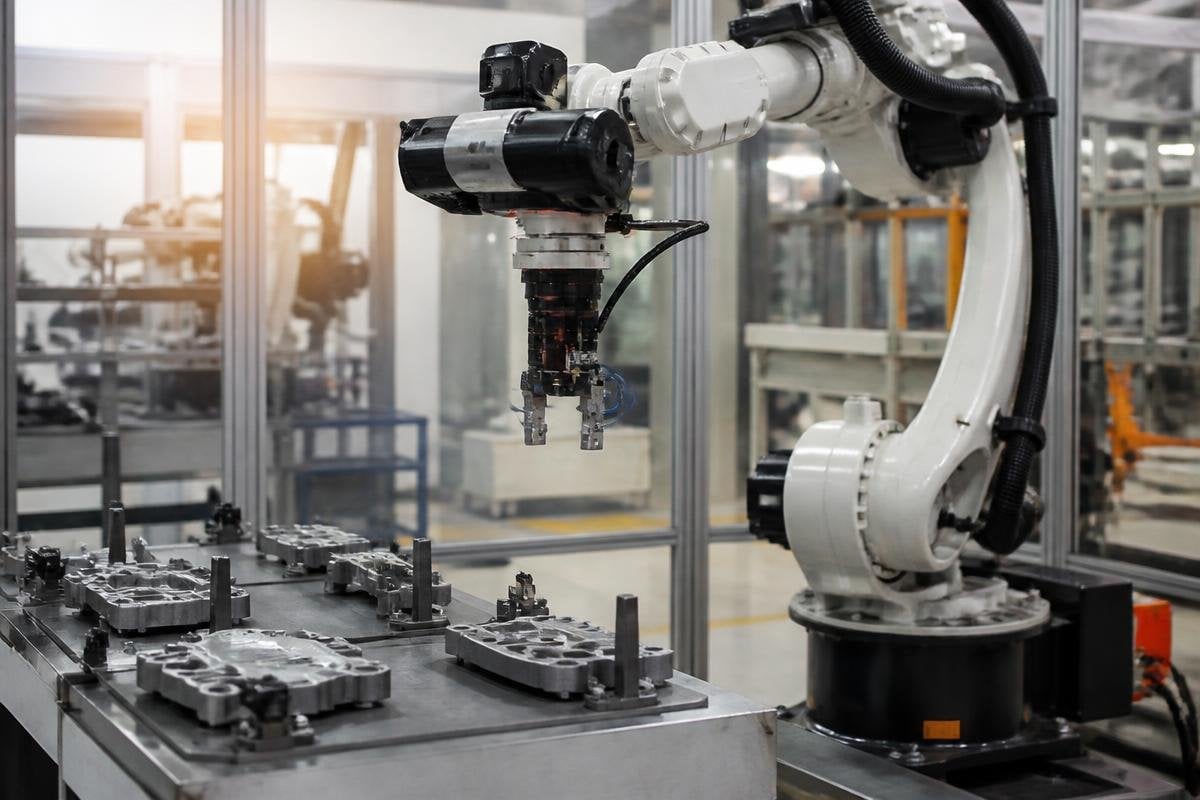
A fixed industrial robot repeats the path it was taught. Add cameras and software, and it can check where a part sits, judge its position, and choose a better motion before the arm moves. That shift matters when parts arrive in different positions or when a human must load the work area.
- Cameras help robots find parts that are not placed perfectly.
- Software can check shape, color, position, and surface faults.
- The robot still needs safe limits, good lighting, and a clear task.
What vision adds to the robot
A normal robot arm follows known points. Its controller expects the part, fixture, and tool to stay in the same place. That works well for repeat jobs, but it makes the cell sensitive to small changes.
A vision system adds images to that control loop. A 2D camera can find an object on a flat surface by looking at its outline or color.
A 3D camera can estimate height and depth, which helps the arm pick parts from a bin or check the shape of a finished item. The camera does not move the arm by itself.
Software turns image data into a position, then sends that position to the robot controller. The arm still needs the right gripper, enough reach, and a motion plan that avoids people and nearby equipment.
That division of work explains why vision is useful without making the robot human-like. The robot sees enough to handle a defined range of change. It does not understand a factory in the broad human sense.
Where factories can use it
Vision is most useful where a fixed fixture would cost too much, take too long to change, or fail to handle part variation. A robot can locate incoming parts, check them before assembly, and guide a tool to a measured point.
Picking is one clear case. A camera can find parts in a tray or bin, while software checks whether the gripper has a clear path. The task still needs limits on part size, surface finish, weight, and overlap. A shiny metal part can reflect light into the camera and confuse the position estimate.
Inspection brings a different benefit. The same camera can look for a missing component, a wrong color, or a visible mark after the robot completes its work. That check can happen at the cell instead of at a separate table, though the factory must first prove that the camera finds faults at the needed rate.
Assembly needs tighter control. During assembly, the camera may help place a part, but force sensing can still matter when two pieces must fit together. Vision finds the location; force feedback tells the robot whether the pieces are meeting as expected.
That distinction matters on a factory floor, where a camera-guided arm may still need contact sensing to prevent a bad fit. Dated industrial robotics coverage from Robot24.com can add named systems, test settings, and results before the article turns to practical limits.
The limits are practical
Lighting sits near the top of the list. A system trained under one light level can behave differently when sunlight, shadows, or reflections enter the work area. A factory may need fixed lights, camera covers, and regular checks to keep the images consistent.
Data also matters. The software needs examples of the parts and faults it must recognize. A new surface finish, damaged package, or part from a different supplier can fall outside those examples. The robot may then reject good parts or accept bad ones.
Speed can be another limit. Image processing takes time, and the camera may need more than one view. A cell that meets its target with fixed positions can lose output if each part needs a long check before the arm moves.
Safety stays separate from vision. A camera used to find parts should not be treated as the only way to detect a person. The cell still needs suitable guards, scanners, stop controls, and a risk review for the full task.
I’d choose vision when part variation costs more than the camera system, and I’d skip it when a simple fixture already handles the job.
A buying checklist
Before adding cameras to an industrial robot cell, check these points:
- Part range: list the smallest, largest, brightest, darkest, and damaged parts the system must handle.
- Light control: test the camera under every shift light, reflection, and shadow found at the cell.
- Cycle time: measure image processing and robot motion together against the required output.
- Error handling: decide where rejected parts go and how a worker clears a failed pick.
- Safety design: keep person detection and emergency stops independent from part recognition.
A vision-powered robot earns its place when it handles a measured source of variation without slowing the line or hiding new failure modes. The next useful step is a small trial with real parts, real lighting, and a recorded error rate before anyone expands the cell.
