


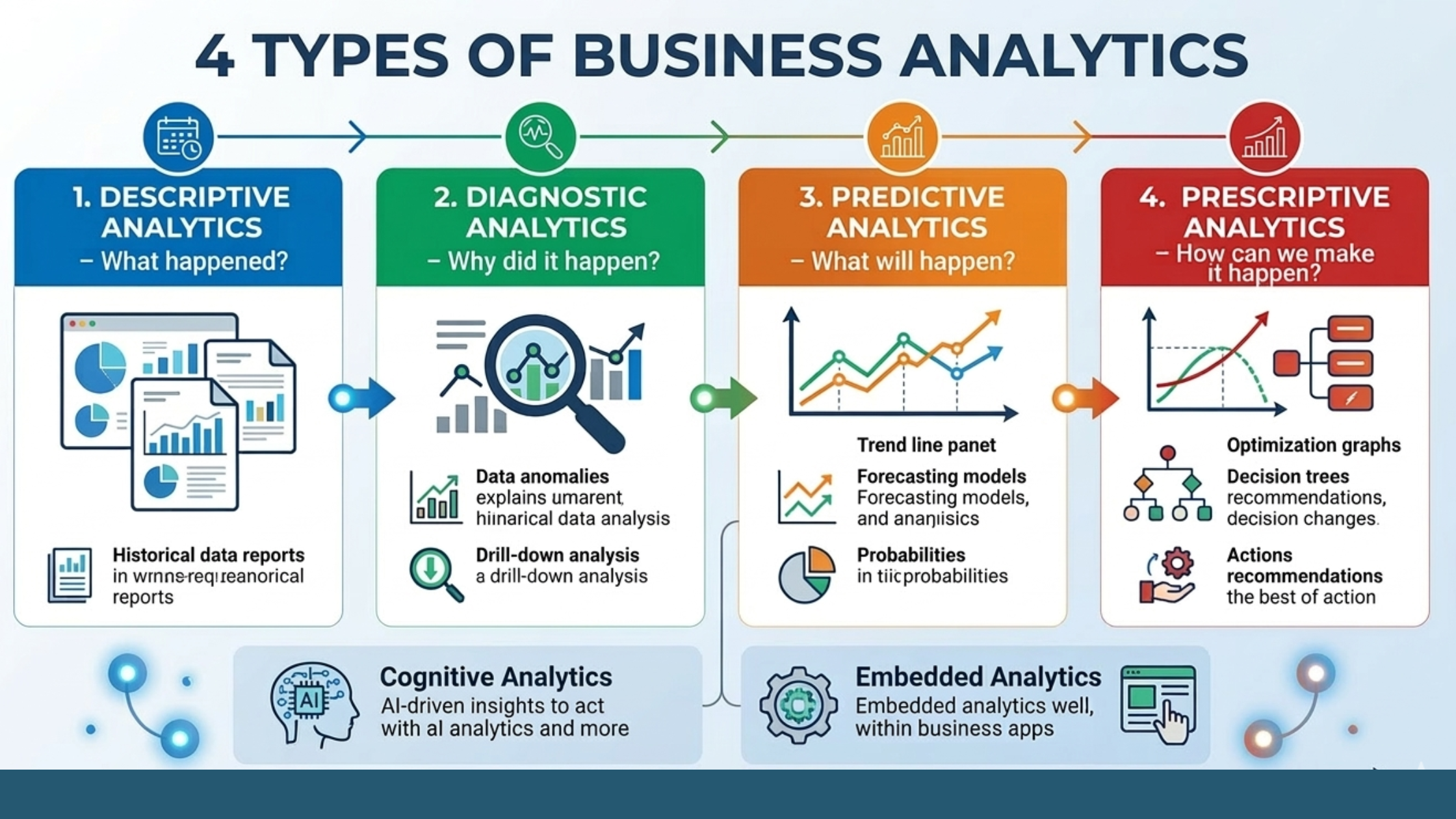
If you have started exploring data analytics for your business, you have probably encountered a lot of terminology that gets thrown around without much explanation. Descriptive, diagnostic, predictive, prescriptive — these words sound technical, but the concepts behind them are actually quite intuitive once someone takes the time to explain them clearly. Understanding these four types of analytics is not just an academic exercise. It gives you a practical framework for thinking about where your organization currently stands, what kind of analytical capability you need to build next, and how to have more productive conversations with data analytics services providers when you are evaluating your options.
Why the Four Types Matter for Your Business
Most businesses do not have a shortage of data. What they have a shortage of is clarity about what questions their data can answer and what type of analytical work is required to answer those questions. The four-type framework solves that problem by giving you a clear map of the analytical landscape. Each type addresses a different category of business question, requires different tools and techniques, and delivers a different kind of value. Knowing where each type fits helps you invest in the right capabilities for the decisions you actually need to make rather than chasing analytical sophistication for its own sake.
It also helps you understand why some analytics investments deliver more value than others. Organizations that invest heavily in descriptive reporting without progressing to diagnostic and predictive capabilities are leaving a significant portion of the potential value of their data untouched. The four-type framework makes that gap visible and gives you a vocabulary for closing it strategically.
Type One: Descriptive Analytics
Descriptive analytics is the foundation of the entire analytics pyramid, and it is where every organization’s analytics journey begins. It answers one fundamental question: what happened? Every report you have ever reviewed, every dashboard you have ever checked, every monthly business review you have ever sat through has been built on descriptive analytics. It takes historical data and organizes it into a form that humans can understand and interpret.
The outputs of descriptive analytics are the things most business people think of first when they imagine analytics work: sales reports broken down by product, region, and time period; website traffic summaries showing page views, bounce rates, and conversion metrics; operational dashboards showing production volumes, error rates, and cycle times; financial statements summarizing revenue, expenses, and margins.
Descriptive analytics is valuable because it creates visibility. You cannot manage what you cannot see, and descriptive analytics is the mechanism through which organizations develop visibility into what is actually happening across their operations. According to a 2024 Dresner Advisory Services survey, 87% of U.S. businesses use some form of descriptive analytics, making it the most universally adopted category. The challenge is that many of those organizations stop here, missing the far greater value available from the analytical types that build on this foundation.
The limitations of descriptive analytics are equally important to understand. It tells you what happened but not why it happened, what will happen next, or what you should do about it. Looking backward has value, but it is inherently limited as a guide for forward-looking business decisions. This is where the next type of analytics becomes essential.
Type Two: Diagnostic Analytics
Diagnostic analytics takes the visibility that descriptive analytics creates and deepens it by asking why. When your sales dashboard shows that revenue dropped 12% last month, diagnostic analytics is what you use to figure out whether that drop was driven by a specific product line, a particular customer segment, a regional issue, a competitive factor, or something in your own operational performance. It moves you from observation to understanding.
The techniques used in diagnostic analytics include drill-down analysis, data mining, correlation analysis, and root cause investigation. These approaches look for patterns and relationships in your data that explain the outcomes your descriptive reports are showing you. Advanced analytics services and solutions in the diagnostic category often involve significant data integration work because understanding why something happened frequently requires connecting data from multiple systems that do not naturally talk to each other.
A retail chain notices through descriptive analytics that customer returns are increasing. Diagnostic analytics might reveal that the increase is concentrated in a specific product category, purchased predominantly by customers acquired through a particular marketing channel, during a specific time window. That level of understanding is not just interesting, it is actionable. It points directly toward the intervention required, whether that is a product quality investigation, a marketing channel review, or a supplier conversation.
The business value of diagnostic analytics is that it replaces expensive guesswork with evidence-based understanding. Organizations that rely on intuition to explain why things happened are frequently wrong in ways that lead to costly interventions that address the wrong problem. Diagnostic analytics dramatically reduces that error rate and the wasted resources that go with it.
Type Three: Predictive Analytics
Predictive analytics is where advanced analytics service work starts to feel genuinely transformative for most organizations. Rather than looking backward at what happened or sideways at why it happened, predictive analytics looks forward to answer what is likely to happen next. It uses statistical models, machine learning algorithms, and historical pattern recognition to generate probabilistic forecasts about future outcomes.
The range of business applications for predictive analytics is extraordinarily broad. Demand forecasting predicts what customers will want to buy and when, enabling more efficient inventory management and production planning. Customer churn prediction identifies which customers are at risk of leaving before they actually go, enabling proactive retention interventions. Credit risk modeling predicts the likelihood that a loan applicant will default, enabling more accurate and consistent lending decisions. Equipment failure prediction identifies machinery that is likely to fail before it actually does, enabling maintenance that prevents costly downtime.
What makes predictive analytics particularly powerful is the asymmetry between the cost of the prediction and the cost of being wrong without it. A retailer that can accurately predict demand avoids both the lost sales of stockouts and the carrying cost of overstock. A financial institution that can predict credit risk more accurately makes better lending decisions across hundreds of thousands of applications. The value compounds with scale in ways that make predictive analytics one of the highest-ROI investments many organizations can make.
A 2025 McKinsey Global Institute analysis found that organizations with mature predictive analytics capabilities outperformed their industry peers by an average of 23% on revenue growth and 19% on profitability over a five-year period. Those are not marginal differences. They reflect the compounding advantage of consistently making better forward-looking decisions than your competitors.
Type Four: Prescriptive Analytics
Prescriptive analytics is the most sophisticated of the four types, and it is the one that is advancing most rapidly thanks to developments in artificial intelligence and machine learning. Where predictive analytics tells you what is likely to happen, prescriptive analytics tells you what you should do about it. It moves from forecasting to recommendation, from prediction to decision support.
Advanced analytics services in the prescriptive category use optimization algorithms, simulation models, and AI-powered decision engines to evaluate multiple possible courses of action, model their likely outcomes, and recommend the option most likely to achieve your defined objective. A supply chain prescriptive analytics system does not just predict that a disruption is likely. It recommends the specific rerouting, inventory reallocation, and supplier substitution actions that minimize the impact of that disruption given your current constraints and priorities.
Pricing optimization is one of the most widely adopted prescriptive analytics applications in retail and e-commerce. A prescriptive pricing system continuously analyzes demand patterns, competitive pricing, inventory levels, and margin targets to recommend optimal prices for each product at each point in time, automatically. Hotels and airlines have used sophisticated versions of this approach for decades. What is new is that the technology has become accessible to businesses of all sizes and all sectors.
Route optimization for logistics and delivery, workforce scheduling, marketing budget allocation, and clinical treatment pathway optimization in healthcare are all areas where prescriptive analytics is delivering significant value. The common thread is that all of these involve complex decisions with many variables and constraints where human intuition consistently underperforms systematic optimization.
The limitation of prescriptive analytics is that it requires clearly defined objectives and high-quality data across all the variables that influence the decision being optimized. It also requires organizational willingness to act on recommendations that may not align with intuition, which represents a genuine change management challenge in some cultures. Organizations that have built strong descriptive and predictive foundations, and that have developed a genuine data-driven culture, are best positioned to extract full value from prescriptive analytics.
How the Four Types Work Together
Understanding the four types as a progression rather than as independent categories is important for how you think about building your analytics capability over time. Each type depends on the one before it. You cannot effectively diagnose why something happened without reliable descriptive data about what happened. You cannot build accurate predictive models without understanding the causal relationships that diagnostic analytics reveals. And prescriptive analytics that recommends what to do is only as good as the predictive models it builds on.
This progression has practical implications for how you engage with data analytics services providers. An organization that has not yet built reliable descriptive analytics across its key business domains is not ready to jump straight to machine learning-powered prediction. The foundational work is not glamorous, but skipping it is one of the most common reasons analytics investments fail to deliver expected value.
The good news is that progress through the maturity levels is achievable for organizations of any size with the right approach. Start by getting your descriptive reporting right, making it reliable, timely, and genuinely connected to the decisions your leadership team makes. Then invest in building diagnostic capability around the questions that matter most. Add predictive capability in the areas where forward-looking insight would change your decisions and where you have enough historical data to build reliable models. Prescriptive optimization follows naturally as your data infrastructure and analytical culture mature.
Conclusion
The four types of data analytics represent a clear and practical roadmap for building the analytical capability your business needs to compete effectively in a data-driven world. Descriptive analytics creates visibility into what is happening. Diagnostic analytics builds understanding of why it is happening. Predictive analytics enables anticipation of what will happen next. Prescriptive analytics drives optimized decisions about what to do about it. Knowing where your organization stands on this progression and where the highest-value opportunities to advance lie is the starting point for making analytics investments that deliver real and measurable business results.
