


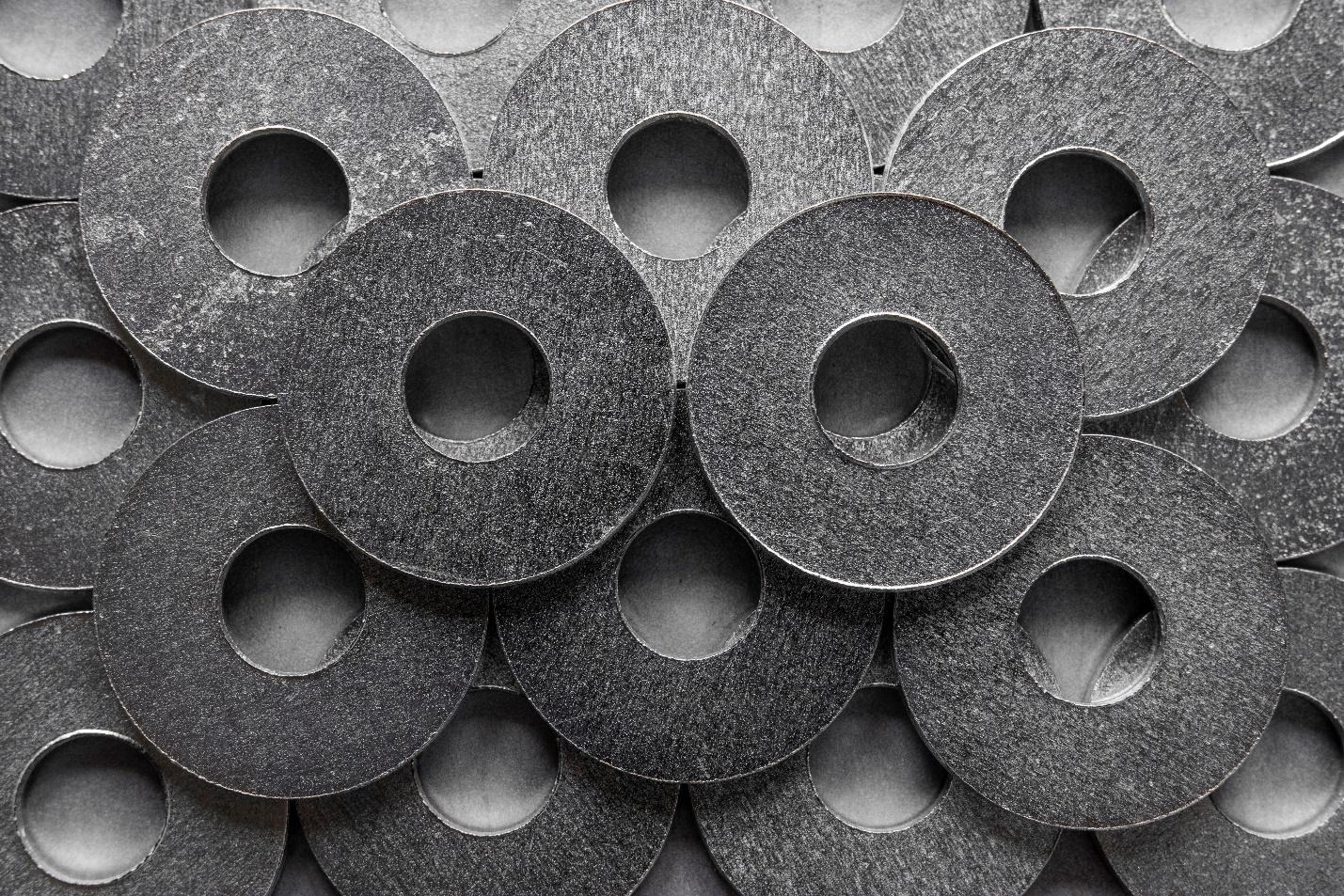
Tungsten carbide is a hard and tough chemical compound. It is formed by fusing tungsten and carbon atoms in equal, precise ratios.
In coating, it is usually manufactured as a ceramic powder, which is then fused with a metallic binder to produce the hardest form of ceramic.
It’s indispensable in modern industries due to its remarkable properties. In today’s article, we’ll talk about some of those properties and how they work well in demanding environments. Let’s get started.
Chemical Composition
In this material, tungsten and carbon atoms are arranged in a hexagonal crystal structure. By weight, 94% tungsten and 6% carbon is commonly used in the industry.
This composition can be further modified by adding a binding material (such as nickel or cobalt) to impart unique properties.
This material is engineered in powder form to achieve a specific particle-size distribution. It also impacts the final coating performance. The powder manufacturing process controls the properties to ensure extraordinary coating quality.
Physical Properties
Tungsten carbide metal exhibits impressive physical properties, making it ideal for a range of industrial applications. It is used a lot in high-impact environments due to its high density (which provides stability in those harsh climates). It also has one of the highest melting points among engineering materials.
The bond length between tungsten and carbon atoms also directly affects the structural stability of the metal. Similarly, it’s a great conductor of heat and so works amazingly well in high-temperature operations.
If your project requires stability and thermal resistance for operational success, this material won’t disappoint.
Mechanical Properties
It’s almost as hard as diamond, offering exceptional wear resistance in abrasive environments. Similarly, it doesn’t deform even under extreme pressure. And under higher load, it shows minimal to no deflection.
If we talk about stiffness, it has a Young’s Modulus of 530-700 GPa (which is thrice as high as steel). Similarly, if you add cobalt or nickel as a binder, you’ll create a kind of cemented carbide, which adds extra layers of toughness.
These properties combine to create a material used in processes where failure isn’t an option. Failure in those processes means there would be delays of weeks or even months in the production.
Advantages of Using Tungsten Carbide
It’s a material of choice in industries where processes are highly demanding and tough. First of all, it has exceptional wear resistance. This means that components made from this material have a longer lifespan. The precision application requires excellent thermal stability, and tungsten carbide just delivers that. The material also has outstanding chemical resistance against acids and alkaline solutions.
Its dimensional stability ensures components perform consistently over time. In a particle-laden fluid environment, it shows superior erosion resistance.
In short, the material is uniquely equipped to make industrial processes way easier and more robust.
Bottom Lines
If you work in industrial settings and want to make long-lasting components, choosing tungsten carbide should be your best bet. It’s hard, tough, and resilient enough to meet a range of your different needs.
